

APOSTILLE AND LEGALISATION
In the case of documents intended for foreign authorities, it is often necessary to submit a sworn and legalised translation.
Legalisation is the next step after asseveration and consists of affixing a stamp (called an ‘Apostille’ if a state has acceded to the Hague Convention) at the court attesting to the legal status of the public official who signed the sworn statement and the authenticity of the official’s signature itself.
APOSTILLE AND LEGALISATION
In detail


WHAT ARE APOSTILLE AND LEGALISATION?
Legalisation and Apostille both serve to ascertain the validity and provenance of documents (civil status records and public acts) intended to be presented in another country.
In practice, they consist of affixing a stamp, on the original document, which officially certifies:
- the title of the public official who signed the document;
- the authenticity of the official’s signature;
- the authenticity of the seal/stamp affixed to the document.
NB: The content of the document is not certified.
WHEN ARE THEY REQUIRED?
Legalisation/Apostille must be affixed to documents intended for presentation in a foreign country. Therefore, an Italian document to be presented abroad will have to be legalised or apostilled before being translated. Likewise, a document coming from abroad will have to be legalised or apostilled in order to be valid in Italy.
WHO ISSUES THEM?
Depending on the document in question, the authority responsible for affixing the legalisation/ Apostille changes:
Italian documents to be presented abroad
- Civil status records: Government Commissioner’s Office (Province of Trento and Bolzano), Prefecture (other regions)
- Judicial and notarial acts: Court
The legalisation/Apostille procedure of the original document is normally followed by the legalisation/Apostille procedure of the certified translation at the court.
Foreign documents to be presented in Italy
- Legalisation/Apostille must necessarily be requested in the country where the document is issued.
Once the translation has been sworn in, no further formalities are necessary.
WHAT IS THE DIFFERENCE BETWEEN LEGALISATION AND APOSTILLE?
As said, the function is the same. What one must pay attention to is the country to which the document is destined. Countries that have acceded to the 1965 Hague Convention require Apostille, all others require legalisation. Therefore, when requesting the service, it is always necessary to specify the country where the document will be presented.
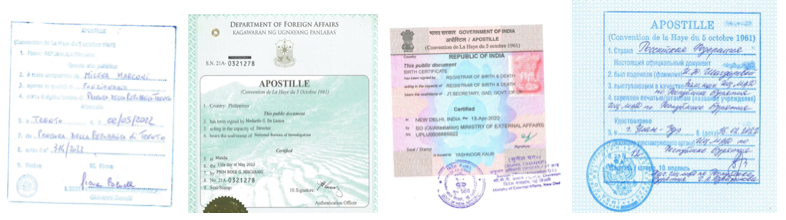
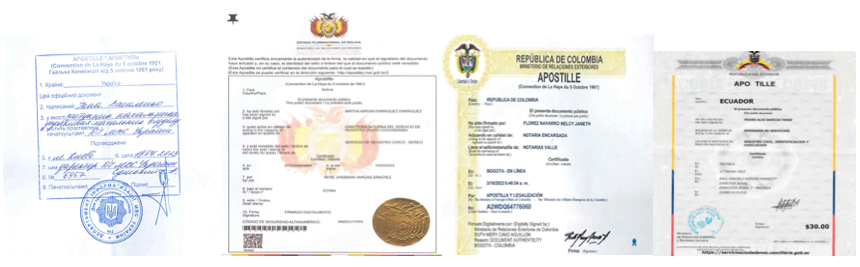
Visually, the Apostille usually appears as a square-shaped stamp/sticker/tablet
CONSULAR LEGALISATION
Documents issued by any consulate can be legalised at the Government Commissariat/Prefecture.
A €16.00 revenue stamp is required for this practice.